Tuesday, October 7, 2014

Garigari vs Berobero (Nippon Television, 1971)

I’m freaking done with wikis! All of them!

I am done with these blasted information ports, where it's either impossible to contribute, or some ‘veteran member’ deletes your work, without any consideration. Especially since my additions to sites like Wikipedia and Wikizilla were far from fanciful non-sense.
And my own attempts at creating an original Kaiju wiki, was constantly undermined by hackers, spam-text, viruses, and similar digital vandalism. This seems to be a problem for a lot of other people's better made wikis. Anime ones in particular.

So screw it! And happily so I might add!

All the amazing Kaiju information and images that I've collected since I was nine-years old(!) will be shared here, and here alone!

Long live my rarely visited blog!


Had you frequented giant monster-related ‘image dump sites' like Tumblr or Pinterest, than you might have come across the humorous rivals shown above.

Garigari vs. Berobero was a segment (or series of segments) from “Machaaki Maetake Hajimaru Yo” (literally “Begins Only with Machaakimae”); a 1971 Japanese comedy series which aired on Nippon Television (or NTV for short).

Garigari is the three-legged bird monster, while his more colorful opponent is Berobero, who's an overweight (fat) Chinese Dragon.

And that’s all I really know about these two rather obscure TV monsters,  though if more information comes my way, I’ll be sure to post a follow-up.

Until such a day arrives (if ever), here’s some more images for your viewing pleasure. Including vinyl toys of Garigari and Berobero, done for contemporary hobby collectors.


Special thanks to Famicomblog, Astro Monsters, and Nerd One at Flickr for these images.

Saturday, October 4, 2014

Moguera Was Once A Real Boy!

As mentioned in my previous post on Roboes,  robots and other similar automatons are awesome! So I think I’m going to continue that line of thinking.

Because again, ROBOTS ARE AWESOME!


Despite the success of 1954’s “Gojira”, and its American adaptation “Godzilla, King of the Monsters” in 1956, Toho Studios didn't exactly begin the Godzilla franchise in full, until 1962.
Especially after the sequel “Godzilla Raids Again” (1955), failed to click with audiences, along with its pretty terrible 1959 American version “Gigantis the Fire Monster”.

“Gigantis” is a whole article of woe all on its own. But let’s just say that the renaming of a popular character like Godzilla, in an decade without the internet, or reliable entertainment news sources, did not go over well.

Thankfully for fantasy fans, Toho continued their string of science fiction and monster movies throughout the fifties. They just did it without Godzilla.

Among these were 1957’s “The Mysterians” (alias “Chikyū Bōeigun”, or "Earth Defense Force"); a Japanese take on the attempted alien invasions of Earth narrative. And one that also manages to do some things different, from the older American efforts which inspired it.

It was filmed in glorious color, and had a very decent budget, as it's often forgotten that Japanese monster movies were technically A-level productions. Until the downgrading of the 1970's. And featured plenty of cool super weapons and vehicles on both sides of the  interplanetary conflict.

Much more intriguing than how these alien invasion film’s usual play out, with the aliens having all the fun toys, and the human heroes only whipping up one useful, but otherwise unimpressive trinket to defeat the invaders at the end.
Including computer viruses programmed by David Levinson, and yodeling from vintage country music albums.

And straight from The Mysterians’ toy chest, comes the giant burrowing robot dubbed Moguera.


Moguera (as in Mole), may not be the first robotic Kaiju in Japanese fiction, but he is the first prominent one featured in the Kaiju film genre.
And although he / it has not appeared in more than two films, the original 1957 version of the character remained a mainstay in Kaiju / Godzilla merchandising for years.

Moguera is a giant burrowing robot used by The Mysterians to first help construct their underground headquarters on Earth. And then later, unleashed upon the surface as the first violent example of their otherworldly power. Despite the robot’s destructive presence and laser beam eyes, Moguera is taken out with multiple explosives across Koyama Bridge.

A second Moguera unit is briefly seen during the climax, as it creates ground fissures to swallow up the human’s own gigantic super weapons dubbed Markalites (mobile energy-shooting satellite dishes). Only to be destroyed by its own handy work, as one of the Markalites falls on top of it.

'Moguera 2', about to be crushed by a falling Markalite Cannon

A heavily reimagined Moguera, now called M.O.G.U.E.R.A (an acronym for Mobile Operation Godzilla Universal Expert Robot Aero-Type), appears in “Godzilla vs Space Godzilla” (1994). This human-built military machine is a successor to the previous year’s Mechagodzilla, whose pilot crew fights alongside Godzilla (however reluctantly), against his cosmic doppelganger.

I’m pretty supportive of almost any giant monster out there, but given a choice between the two Moguera automatons, I’ll take the 1957 vintage any old day.

Moguera (the first one) on the warpath!

The original story for “The Mysterians” had no monster in it, as Mogera's inclusion was a last minute idea from producer Tomoyuki Tanaka, whom felt the film needed a Kaiju. Bless him.

The original concept for Moguera was to have him / it be a half-mole, half-reptilian creature. Though the design was never brought to special-effects-suit life, some key details were later used for another burrowing giant, Baragon, from the 1965 film “Frankenstein Conquers the World”.

Director Ishiro Honda reworked Moguera into being a robot, as a way to further demonstrate the technological powers that The Mysterians possessed. Below is a compilation piece I put together, featuring design art and storyboards of the abandoned flesh and blood Moguera.


And plenty of alternate files of the unrealized Moguera, that you readers are welcomed to collect and share elsewhere online.


Thursday, September 11, 2014

Pachimon Kaiju Showcase: Roboes

By this point, you all know the drill of what a Pachimon Kaiju is, and the story behind these odd bromide cards. However, I’m starting to realize that the term itself (which translates as ‘stolen monster’) might be true even for the original monster designs, and their related artwork.

There was a lot of Japanese picture books made for children during the Golden Age of Japanese Giant Monsters (the 1960’s Kaiju Boom). And a lot of said illustrations could have been re-purposed (borrowed) for these bromide cards.

But then again, maybe I’m just being paranoid here. And last showcase’s Danopura may have made his exclusive debut, in the same Pachimon card which featured him. And that’s my thought process behind today’s subject - the highly unimaginatively named Roboes!


Roboes (also known as Robosu), is probably one of my more favorite characters from these wacky cards.

I would argue that fictional robots are the coolest monsters in all of worldwide fantasy. Especially since they have a greater variety than other monster types, like Zombies, Vampires, or Werewolves, who often must abide to their respective and rigid genre rules.

Make a Zombie that can utter a single word of basic English? Zombie purists and the casual horror fans alike will give you unjust Hell for this one little detail!

But create magical clockwork robots in a fantasy fairy tale kingdom? Or demonic techno-organics (a more extreme take on the cyborg concept) for a grim space adventure? The only real guff you may get will be from the handful of sulking weenies who simply don’t like robots to begin with.

Despite all the ‘Giant Monster vs Giant Robot’ debates you'd find across the internet (First World problems indeed), for someone like myself, its a mute argument. Because there’s giant monsters out there who also happen to be giant robots! The best of both worlds!

And like the aforementioned, these too can come in a wide variety of shapes and story possibilities.

And that’s why I have a certain affinity for Robosu and his jumbo-sized mechanized ilk, because giant robots are almost always better than the regular sized ones.

But even if that wasn't the case, Roboes has a very fun design. Highlighted by an awesome red-coloring scheme, which separates him from the silvers and grays of most other robotic Kaiju.

The retro-pulp feel of Roboes makes it feel like it could exist as an actual creature suit. Or the chosen battle mecha of choice for Ming the Merciless, of “Flash Gordon” fame.

If there is one thing I don’t like about Roboes’ otherwise cool design, is the huge ‘spoon fingers’ on its hands. But that’s a minor complaint, and would still keep them if I could translate the artwork above into physical cosplay (convention costume) form.

Alternate file version of the same Roboes bromide card.

Next Time on the Pachimon Kaiju Showcase: as promised to a fellow Pachimon fan Dr Zock, we'll be discussing the bizarre vampire ace of spades known as Kyuradoros.

Friday, August 29, 2014

Pachimon Kaiju Showcase: Danpuraa

Although only the third entry into this series, this is the first fully original monster featured in our Pachimon Kaiju Showcase, as opposed to photo-edited redesigns of existing movie, or television characters.

Danpuraa (alias Danpurar, or Danopura) is a plump quadruped, with heavy mammalian features, like some sort of wonderfully freaky walrus beast from a “Flash Gordon” comic strip. And despite not being as large as most Japanese giant monsters, Danpuraa is nonetheless causing destruction by crushing cars, and setting off nearby explosions.


Of course, the stiff upper lipped London pedestrians could care less, as they casually walk away from the mayhem. And virtually giving Danpuraa little, to no attention what-so-ever.

Now I don’t like to harp upon the limitations of artists back in the day, especially since they were able to accomplish a lot with said limitations, than most computer savvy photo-shoppers of today could do with more (myself included).

But little oddball details like the un-amused Londoners are still immensely fun to point out.


Sunday, August 3, 2014

Pachimon Kaiju Showcase: Tobozu

Pachimon is the collective shorthand used for various Japanese bromide trading and playing cards from late 1960's and early 1970's featuring original Kaiju (giant monsters), created through both drawn illustrations and photo manipulations from more famous creatures from Japanese films and television.

Despite the wealth of fully original characters from these bromide cards, it was the 'rip-off photos' that gave Pachimon (Japanese for 'stolen monsters') its more infamous reputation; terrible shame of inaccuracy and people's misconceptions, really, and I'm no better either, by continuing my series of Pachimon Kaiju articles with said infamy.

Today, we have Tobozu (sometimes called Tohboze), who seems to be some type of sea monster who's invading a ship filled harbor. Many of you will immediately notice that Tobozu is a thinly disguised Gamera, lacking his original turtle shell, given a brown / orange-ish colored skin in place of the original dark green, uneven looking head spikes, and an extended under-bite.


But what really gets my interest is the small group of vacationers by Tobozu's hands / feet who haven't noticed or simply just doesn't care about their approaching doom. If you think that tidbit with the oblivious causalities is hilarious, I'll introduce you all to the London-based Danopura next time!

Before I leave you, I'd like to share my own artistic interpretation of Tobozu which is less of an educated guess on the monster's off-camera body shape than I just simply copying Japanese fan art of Tobozu, notably the Mugen video game versions.


Further Reading and Viewing Online:

Wikipedia Article on Gamera
Trailer for Gamera's 1965 Debut
More Pachimon Kaiju Images

Sunday, July 13, 2014

Pachimon Kaiju Showcase: NOT Godzilla

Pachimon, or Pachimon Kaiju, is a term used for various Japanese bromide cards published around the early 1970's. These bromide cards were known for featuring bizarre imitation monsters, directly and indirectly based on more famous characters, if not outright stealing the likenesses completely through pre-digital methods of photo manipulation; hence the term Pachimon, 'Pachi' as in stolen, and 'Mon' as in monster.

Of course, this being simple 'fan slang', the term Pachimon is quite misleading as a good number of these bromide cards also featured fully illustrated, originally designed creations. Hopefully a better terminology will make itself present in the near future but, for now, we'll just refer to these cards collectively as Pachimon Kaiju.

Pachimon are quite obscure as it is, so instead of doing what every other blog has done in the past by uploading these visual oddities in bulk, I'm going to showcase these images a little at a time, along with my own personal insight towards the monster designs featured.

I'm going to start with two Godzilla-based rip-offs, just to get greater exposure among the more fickle American-based Kaiju fans, and to show off just how extreme the 'borrowed likeness' side of these cards truly went.


Above we have the mid-60s Godzilla suit altered with huge ears and a slightly larger bird-like beak. This entry hails from a particular series published by the company Yokopro which had giant monsters menacing foreign landmarks and countries around the world. Despite the Katakana on the bromide card itself (which simply translates as New York), this bird-beaked Godzilla has no real, proper Kaiju name, but a re-purposed playing card reissue of the image does rectify this.


The playing card names the monster Wadorisu (which can also be read as Waadorisu or Wardorisu). Wadorisu is a name that, to me at least, seems to match perfectly with the design's funny beak and ears.

Not much else to say on this New York Pachimon other than that the poor Statue of Liberty was getting harassed by monsters long before baby Cloverfield came along!


Now onto our second Godzilla knock-off who's been altered oh-so-slightly with a neck-frill and porcupine-style spines. The lower line of katakana on this image roughly translates as Yakobu which also means 'Jacob' in Japanese, however, I no idea if this is the monster's name or the airport location that its menacing. For now, we'll just refer to this critter as Yakobu whose design and overall card is a lot more appealing than the earlier New York Pachimon.

Actually, it wouldn't be out of the realm of possibly that Yakobu is the Pachimon version of Jirass from "Ultraman", who itself was a refurbished Godzilla suit with an added neck-frill.

If that's the case, then this would be creature design equivalent of painting pure karat gold bars with gold hobby store paint. And then wrapping those golden abominations in shiny, gold colored foil, bought from a party supply shop.

Okay, so maybe its not THAT bad, but Yakobu still has the nicer looking bromide card between the two shown.

Further Reading Online:

All Monsters Blog's Profile of Jirass
More Pachimon Images

Thursday, July 3, 2014

G-G-G-G-Ghost Godzilla!!!

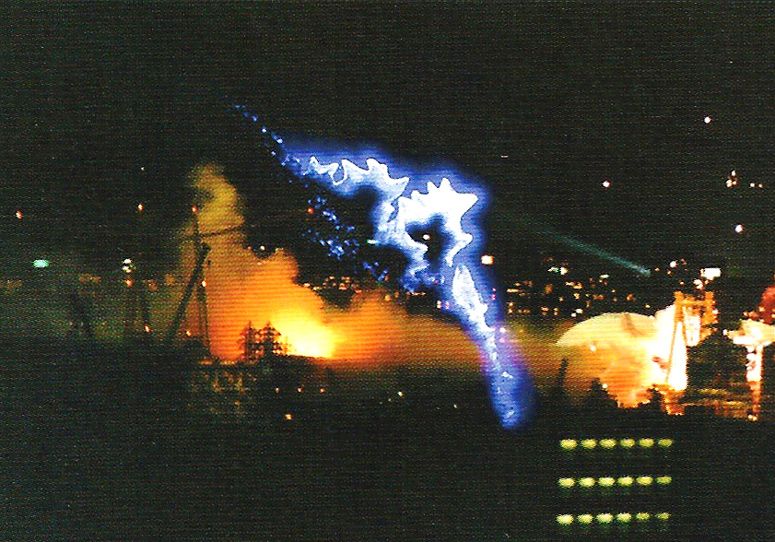
UPDATE: Here's another official piece of concept art, that I totally forgot to upload the first time around. This one features Ghost Godzilla's visible dorsal fins, amongst some city devastation.


I don't have much time for an extensive article, centered around otherwise trivial nonsense. So here's a brief article...also centered around otherwise trivial nonsense!

And surprise, surprise! It's yet another Kaiju (giant monster) related one!

We'll be discussing unproduced, or abandoned monster movies once again, and this time, with one of the more famous examples of such - "Godzilla vs Ghost Godzilla" (1994-1995).

Originally planned as the final film to close out the Heisei-cycle of the franchise (1984-to-1995), "Godzilla vs Ghost Godzilla" had its then-current incarnation of the title Monster King, go up against the supposedly more villainous ghost of his long deceased, 1954 counterpart.

More information on the unmade project can be found at Toho Kingdom.

The concept was dropped, largely due to the previous two entries also featuring 'Evil Godzilla Clones'. Those being 1993's "Godzilla vs Mechagodzilla II", and 1994's "Godzilla vs Space Godzilla". And "Ghost Godzilla" was replaced with the more original (and ultimately filmed) swan song "Godzilla vs Destroyah" (1995).

In recent years, the one piece of conceptional artwork done for Ghost Godzilla himself, has surfaced on several fan forums. But has yet to be properly posted on actual web-sites and blogs.

So 'Why the Hell not?' I figured!

The rough scan that's being presented below, comes from a licensed Japanese Godzilla book. But I currently have no idea to which one, or to said book's title. Enjoy the obscure eye-candy regardless, everybody!


Probably to the disappointment of many fan artists, the 'REAL' Ghost Godzilla is a fairly simple creature design, as it's just the 1954 original, but given a supernatural blue glow and transparency.

Don't get ME wrong though, as it's highly effective for what it is, and most certainly works as a 'Ghost Godzilla'.

But again, this is merely concept art, from the earliest stages of what ultimately became an abandoned production. And no clue how far the filmmakers would have gone with the Ghost Godzilla character, as to wither-or-not he'd transform between multiple other body stages. Much like The Librarian and her secondary 'back-off' form, from the classic comedy "Ghostbusters".

We are talking about the Godzilla films of the 1990's, after all. It's here (with the arguable exception of Godzilla / Burning Godzilla) that almost every creature featured in these movies, had one-or-more different body upgrades.

Like some kind of nightmarish, jumbo-sized precursor, to ludicrous Pokemon Evolution!